Cashier

 Deutsch
 Français
 Español
BlogRestaurants and cafés
Malak Heindy13 min read
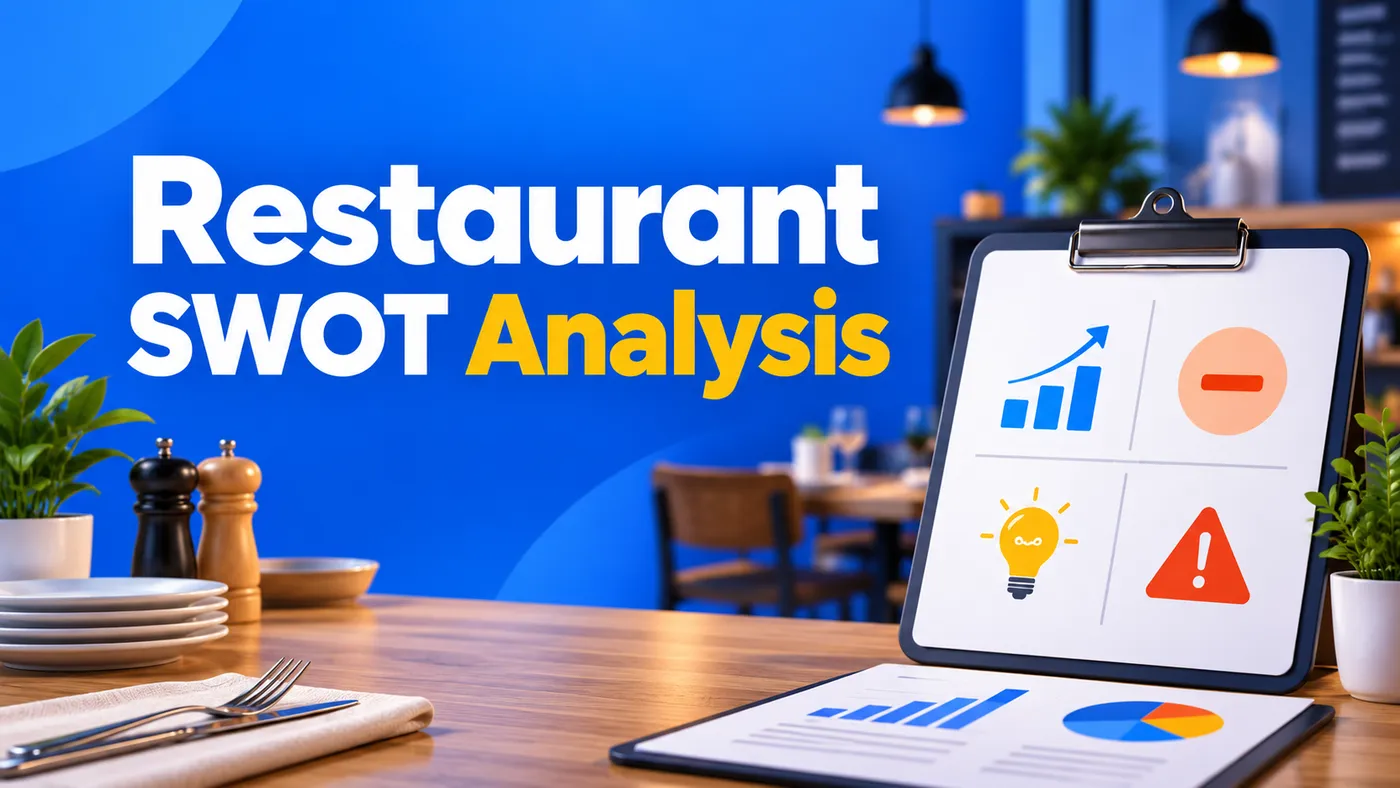
Running a successful restaurant requires more than serving great food. Owners and managers need to understand what the business does well, where operational problems are reducing performance, what opportunities exist in the market, and which external risks could affect future growth. A restaurant SWOT analysis provides a structured way to answer these questions.
SWOT stands for Strengths, Weaknesses, Opportunities, and Threats. By examining these four areas, restaurant owners can develop a clearer picture of their competitive position and make better decisions about pricing, menu development, staffing, technology, marketing, inventory, customer service, and expansion.
However, an effective SWOT analysis should not rely only on assumptions. Modern restaurants generate valuable operational data every day through orders, inventory movements, payments, employee activity, and sales. Using information from a restaurant POS system alongside management experience can make a SWOT analysis significantly more useful.
In this guide, we explain how restaurant SWOT analysis works, provide practical examples, show you how to conduct one step by step, and explore how POS data can help turn strategic observations into measurable actions.
What Is a Restaurant SWOT Analysis?
A restaurant SWOT analysis is a strategic planning method used to evaluate the internal and external factors affecting a restaurant’s performance.
The four components are:
The four components are:
| SWOT Area | Meaning | Restaurant Examples |
|---|---|---|
| Strengths | Internal advantages | Loyal customers, popular dishes, strong location, efficient service |
| Weaknesses | Internal problems | High food waste, slow checkout, inconsistent service, poor inventory control |
| Opportunities | External possibilities for growth | Delivery demand, new customer segments, catering, expansion |
| Threats | External risks | New competitors, rising ingredient prices, economic pressure, changing customer preferences |
Strengths and weaknesses are generally internal factors that management can directly influence.
Opportunities and threats are primarily external factors that a restaurant must identify, prepare for, and respond to.
For example, consistently high sales of a signature dish could be a strength. Frequently running out of that dish because inventory is poorly managed could be a weakness. Growing demand for delivery in your area could represent an opportunity, while a major competing restaurant opening nearby could become a threat.
The value of a SWOT analysis comes from examining these factors together rather than treating them as separate problems.

Why Is SWOT Analysis Important for Restaurants?
Restaurant businesses operate in an environment where small operational decisions can have a significant impact on profitability.
Ingredient costs change. Customer preferences evolve. Employees leave. Competitors introduce new menus. Delivery channels grow. Popular dishes can suddenly become less profitable because their ingredients become more expensive.
Without regular analysis, restaurant owners may continue making decisions based on habits instead of actual performance.
A restaurant SWOT analysis helps management step away from daily operations and look at the business strategically.
It can help you:
- Understand your competitive advantages.
- Identify operational problems before they become larger issues.
- Discover new revenue opportunities.
- Evaluate restaurant profitability.
- Improve menu decisions.
- Prepare for competitive threats.
- Review staffing and service performance.
- Identify technology gaps.
- Build a stronger restaurant business plan.
- Prioritize investments and operational improvements.
The objective is not simply to create four lists. A useful SWOT analysis should lead to specific actions that improve restaurant performance.
The Four Elements of Restaurant SWOT Analysis
Understanding exactly what belongs in each category is essential. One of the most common mistakes in SWOT analysis is confusing internal weaknesses with external threats or treating general business goals as opportunities.
1. Restaurant Strengths
Strengths are the internal capabilities, resources, or characteristics that give your restaurant an advantage.
Ask yourself:
What does our restaurant do particularly well?
A strength should ideally be something that contributes to customer satisfaction, efficiency, revenue, profitability, or competitive differentiation.
Common restaurant strengths include:
- A recognizable brand.
- Excellent customer reviews.
- A loyal base of repeat customers.
- A convenient or high-traffic location.
- Popular signature dishes.
- Strong supplier relationships.
- Experienced employees.
- Fast order processing.
- Consistent food quality.
- Efficient inventory management.
- High-performing delivery operations.
- Strong restaurant profit margins on key products.
- Effective management.
- Modern restaurant technology.
Your restaurant POS data can help determine whether perceived strengths are actually supported by performance.
For example, management may believe that dinner service is the strongest part of the business. Sales reports might reveal that lunch customers actually generate higher average order values or that weekend takeaway orders are growing faster.
This distinction matters because a SWOT analysis should reflect the restaurant’s real performance rather than assumptions.

2. Restaurant Weaknesses
Weaknesses are internal factors that reduce efficiency, customer satisfaction, revenue, or profitability.
Restaurant owners sometimes avoid discussing weaknesses because they feel negative. However, identifying weaknesses is one of the most useful parts of SWOT analysis.
Problems that remain invisible cannot be improved.
Examples of restaurant weaknesses include:
- Slow service during busy hours.
- High employee turnover.
- Frequent inventory shortages.
- Excessive food waste.
- Poorly performing menu items.
- Inaccurate stock records.
- Inconsistent customer service.
- Limited payment options.
- Outdated restaurant technology.
- Dependence on manual sales records.
- Weak financial reporting.
- Low-performing branches.
- Poor communication between kitchen and front-of-house staff.
- Long checkout times.
- Too many discounts reducing profit margins.
Good operational data makes these weaknesses easier to identify.
Suppose a restaurant repeatedly sells out of certain ingredients on Friday evenings. The problem may initially appear to be high demand, which sounds positive. However, inventory reports could reveal that the actual weakness is inaccurate forecasting or insufficient stock management.
A modern POS system can help managers identify patterns like these before they affect customer satisfaction.
3. Restaurant Opportunities
Opportunities are external conditions that the restaurant could use to increase sales, reach new customers, improve profitability, or expand operations.
Unlike strengths, opportunities are not things the restaurant already does well. They are possibilities that could become valuable if management takes action.
Restaurant opportunities may include:
- Growing demand for online ordering.
- Adding delivery or takeaway services.
- Expanding into catering.
- Opening another branch.
- Serving underserved customer groups.
- Introducing seasonal menus.
- Offering meal packages.
- Building a customer loyalty program.
- Partnering with nearby businesses.
- Expanding operating hours.
- Introducing new payment methods.
- Selling high-demand products online.
- Improving upselling and cross-selling.
- Using sales analytics to optimize the menu.
- Adopting better restaurant management technology.
The best opportunities usually combine external demand with an existing internal strength.
For example, imagine a restaurant already has strong lunch sales and is located near several large offices. Corporate catering could represent a logical growth opportunity because it builds on an existing customer segment.
Another restaurant may discover through POS reports that takeaway orders are increasing every month. Investing further in pickup, packaging, or online ordering could therefore become a strategic opportunity.
4. Restaurant Threats
Threats are external factors that could negatively affect restaurant performance.
Because management cannot completely control these factors, the goal is usually to reduce exposure, build resilience, or develop a response plan.
Common restaurant threats include:
- New competitors entering the local market.
- Rising food costs.
- Increasing labor expenses.
- Economic downturns.
- Reduced consumer spending.
- Supply chain disruptions.
- Changes in customer preferences.
- Negative online reviews.
- New regulations.
- Rent increases.
- Supplier dependency.
- Changes in delivery platform costs.
- Technology disruptions.
- Increased competition from online food businesses.
Consider ingredient inflation as an example.
A restaurant cannot control global food prices. However, it can analyze food costs, identify low-margin dishes, negotiate with suppliers, adjust portion sizes where appropriate, revise menu pricing, or promote more profitable alternatives.
A threat therefore becomes much easier to manage when the restaurant has accurate operational information.
How to Conduct a Restaurant SWOT Analysis Step by Step
Understanding exactly what belongs in each category is essential. One of the most common mistakes in SWOT analysis is confusing internal weaknesses with external threats or treating general business goals as opportunities.
Step 1: Define the Objective
Start by deciding what you want to evaluate.
You can perform a SWOT analysis for the entire restaurant or focus on a specific decision, such as:
- Increasing restaurant sales.
- Improving profitability.
- Reducing food waste.
- Launching delivery.
- Opening another branch.
- Updating the menu.
- Improving customer retention.
- Choosing a restaurant POS system.
- Expanding into catering.
- Improving inventory management.
A clear objective makes the analysis more focused.
Instead of asking, “What are our restaurant’s weaknesses?” you might ask, “What internal problems are preventing us from increasing dinner sales?”
The second question is more likely to produce actionable answers.
Step 2: Collect Restaurant Performance Data
Before filling in the SWOT matrix, gather relevant information.
Review:
- Total sales.
- Sales by day and hour.
- Average transaction value.
- Best-selling products.
- Low-selling products.
- Discounts.
- Refunds.
- Inventory movement.
- Out-of-stock incidents.
- Employee performance.
- Branch performance.
- Payment methods.
- Order types.
- Customer complaints.
- Online reviews.
- Food costs.
- Competitor activity.
This is where a restaurant POS system becomes particularly useful.
Instead of manually reviewing receipts or relying on memory, restaurant managers can use POS sales reports to understand what is happening throughout the business.
For example, Cashier POS gives restaurant businesses access to sales, inventory, transaction, cashier, and operational information from one system. Because it works as an online and offline POS, restaurants can also continue processing sales when internet connectivity is unavailable.
The purpose of collecting this data is not to make the SWOT analysis complicated. It is to make it accurate.

Step 3: Identify Your Restaurant’s Strengths
Start with measurable advantages.
Ask questions such as:
- Which menu items generate the most sales?
- Which dishes have strong demand and good margins?
- When are our busiest periods?
- Why do customers return?
- Which branch performs best?
- Are our employees efficient during peak periods?
- What do customers frequently praise?
- Do we have operational advantages competitors cannot easily reproduce?
Avoid vague statements such as “great food.”
A better SWOT entry would be:
“Our three signature dishes generate a large percentage of weekend dinner sales and receive consistently positive customer feedback.”
Specific observations are easier to turn into strategies.
Step 4: Identify Operational Weaknesses
Next, examine what is preventing stronger performance.
Ask:
- Where are we losing money?
- Which dishes sell poorly?
- Are we overstocking certain ingredients?
- Which products frequently become unavailable?
- When are service times longest?
- Are discounts being used effectively?
- Which branch is underperforming?
- Are employees making frequent order errors?
- Do manual processes slow operations?
- Is reporting accurate enough for management decisions?
Be specific.
Instead of listing “inventory problems,” write:
“Popular ingredients frequently run out before weekend dinner service because inventory levels are not reviewed consistently.”
That statement points toward a solution.
Step 5: Research External Opportunities
Now look beyond the restaurant.
Study:
- Local customer demand.
- Competitor menus and pricing.
- Food trends.
- Delivery demand.
- Neighborhood development.
- New business districts.
- Corporate catering possibilities.
- Tourism patterns.
- Customer reviews.
- Technology changes.
- New sales channels.
Not every trend should become an opportunity.
An opportunity is useful only when it aligns with your restaurant’s concept, resources, and target customers.
Step 6: Identify Realistic Threats
Avoid filling the threat section with every possible business risk.
Focus on factors that have a realistic chance of affecting your restaurant.
For example:
- A major competitor opening nearby.
- Significant increases in ingredient prices.
- Dependence on a single supplier.
- Changes in customer traffic around your location.
- Growing competition in delivery.
- Changes to local regulations.
Then estimate both the likelihood and potential impact of each threat.
Step 7: Prioritize the Most Important Factors
A SWOT matrix containing 40 points is difficult to use.
Instead, identify the factors that could have the greatest effect on the business.
For each item, ask:
- How much could this affect sales or profitability?
- How quickly could it happen?
- How much control do we have over it?
- What action can we take?
Prioritization turns SWOT analysis into a management tool rather than a brainstorming exercise.
Then estimate both the likelihood and potential impact of each threat.

Restaurant SWOT Analysis Example
Consider a growing casual restaurant with strong dine-in sales but inconsistent inventory management.
Its SWOT analysis might look like this:
| Strengths | Weaknesses |
|---|---|
| Popular signature menu items | Frequent inventory shortages |
| Loyal local customer base | Slow checkout during peak hours |
| Strong weekend sales | Several low-performing menu items |
| Experienced kitchen team | Limited operational reporting |
| Opportunities | Threats |
|---|---|
| Growing takeaway demand | New competitors nearby |
| Corporate catering | Rising ingredient costs |
| Menu optimization | Increasing labor costs |
| Opening a second location | Reduced consumer spending |
The analysis becomes useful when the restaurant starts connecting these points.
For example:
Strength + Opportunity:
Strong signature dishes combined with growing takeaway demand could justify creating takeaway meal packages featuring those dishes.
Weakness + Opportunity:
Limited operational reporting could be addressed by introducing a modern POS system before opening another location.
Strength + Threat:
A loyal customer base could help protect the restaurant from new competitors if management strengthens customer retention.
Weakness + Threat:
Frequent inventory shortages become especially dangerous when ingredient prices increase. Better stock management and purchasing forecasts should therefore become a priority.
This process transforms four lists into an actual restaurant strategy.
How POS Data Makes Restaurant SWOT Analysis More Accurate
Many restaurant weaknesses are hidden inside everyday operations.
Sales may look healthy while discounts are reducing margins. A menu item may appear popular while producing limited profit. Inventory purchases may increase even though customer traffic remains stable.
A POS system for restaurants helps managers investigate these patterns using transaction data.
Analyze Restaurant Sales
POS reports can help identify:
- Peak sales periods.
- Slow periods.
- Best-selling items.
- Sales by cashier.
- Sales by branch.
- Order type.
- Payment method.
- Transaction volume.
These insights can reveal both strengths and weaknesses.
Evaluate Menu Performance
Restaurant owners should not evaluate menu items only based on popularity.
Management should consider sales volume, pricing, ingredient costs, operational complexity, and profitability.
POS sales information can help identify which products deserve more promotion and which may need to be repositioned, repriced, or removed.

Improve Inventory Management
Inventory issues frequently appear in restaurant SWOT analyses.
Too much inventory can increase waste and tie up cash. Too little inventory can cause stockouts and lost sales.
Connecting sales activity with inventory management makes it easier to understand which products move quickly and when replenishment may be necessary.
Compare Branch Performance
For multi-location restaurants, SWOT analysis becomes even more valuable.
A strength in one branch could be a weakness in another.
For example, one location may have:
- Higher average orders.
- Better cashier productivity.
- Stronger takeaway sales.
- Fewer inventory shortages.
Comparing locations allows management to identify successful practices that could be replicated elsewhere.
Cashier POS supports multi-branch operations, giving restaurant owners greater visibility into sales and operational activity across their locations.
Using Your SWOT Analysis to Improve Restaurant Operations
Completing the matrix is only the beginning.
Every major SWOT finding should eventually become one of three things:
- An action.
- A measurement.
- A decision.
For example:
Weakness: Too many stockouts.
Action: Review inventory levels and reorder processes.
Measurement: Track the number of out-of-stock incidents each week.
Decision: Adjust purchasing quantities based on sales patterns.
Another example:
Opportunity: Growing lunch demand.
Action: Create lunch combinations around popular items.
Measurement: Track lunch transactions and average order value.
Decision: Continue, modify, or discontinue the promotion based on results.
This approach makes SWOT analysis part of continuous restaurant management.
Common Restaurant SWOT Analysis Mistakes
Using Opinions Instead of Data
Management experience is valuable, but assumptions should be tested whenever possible.
If you believe a product is your best seller, verify it using sales reports.
Creating Generic SWOT Entries
Statements such as “good employees” or “strong competition” provide little strategic value.
Be specific about what makes the employees effective or which competitors create a threat.
Confusing Weaknesses With Threats
Remember:
Weaknesses are internal. Threats are external.
Poor inventory management is a weakness.
Unexpected supplier price increases are a threat.
Ignoring Profitability
High sales do not automatically mean strong performance.
Restaurant SWOT analysis should consider efficiency, margins, waste, staffing, and operating costs alongside revenue.
Never Updating the Analysis
Restaurant conditions change.
A new competitor, menu change, supplier problem, new location, or shift in customer behavior can quickly make an old SWOT analysis outdated.
How Often Should a Restaurant Conduct a SWOT Analysis?
There is no universal schedule, but reviewing your restaurant SWOT analysis every six to twelve months is a practical starting point.
You should also conduct one before major decisions such as:
- Opening a new location.
- Launching delivery.
- Redesigning the menu.
- Making a large technology investment.
- Changing pricing.
- Expanding into a new market.
- Introducing a new restaurant concept.
Restaurants operating in rapidly changing markets may benefit from shorter quarterly reviews of their most important SWOT factors.

Restaurant SWOT Analysis Questions to Ask
If you are struggling to start your analysis, use these questions with your management team.
Strengths
- Why do customers choose us instead of competitors?
- Which products generate the strongest sales?
- Which operational processes work particularly well?
- What resources or capabilities are difficult for competitors to copy?
Weaknesses
- Where are we losing revenue or time?
- Which processes generate the most errors?
- What complaints appear repeatedly?
- Which products or periods consistently underperform?
Opportunities
- What are customers asking for that we do not currently offer?
- Are there new customer segments we could serve?
- Could delivery, takeaway, catering, or online ordering create additional revenue?
- Could technology make operations more efficient?
Threats
- Which competitors are becoming stronger?
- Which operating costs are increasing?
- Which suppliers create significant dependency?
- What market changes could reduce demand?
Turn Your Restaurant SWOT Analysis Into Better Decisions
A restaurant SWOT analysis gives business owners a structured way to understand where their operation stands today and where it could go next. By identifying strengths, weaknesses, opportunities, and threats, management can focus resources on the areas that have the greatest impact on customer experience, operational efficiency, sales, and profitability.
The most effective SWOT analyses are specific, measurable, and connected to real restaurant data. Sales trends, inventory activity, menu performance, transactions, employee activity, and branch results can provide valuable evidence behind each strategic decision.
This is also why choosing the right restaurant POS system matters. A modern solution should do more than process payments. It should help restaurant owners understand what is happening throughout their business.
Cashier POS provides a flexible free POS system for restaurant and retail businesses, with online and offline functionality and access across mobile, desktop, and web platforms. By bringing sales, inventory, cashier activity, reports, and daily operations into one system, Cashier POS can help restaurant owners turn operational information into clearer business decisions.
A SWOT matrix shows you where to look. Reliable restaurant data helps you decide what to do next.