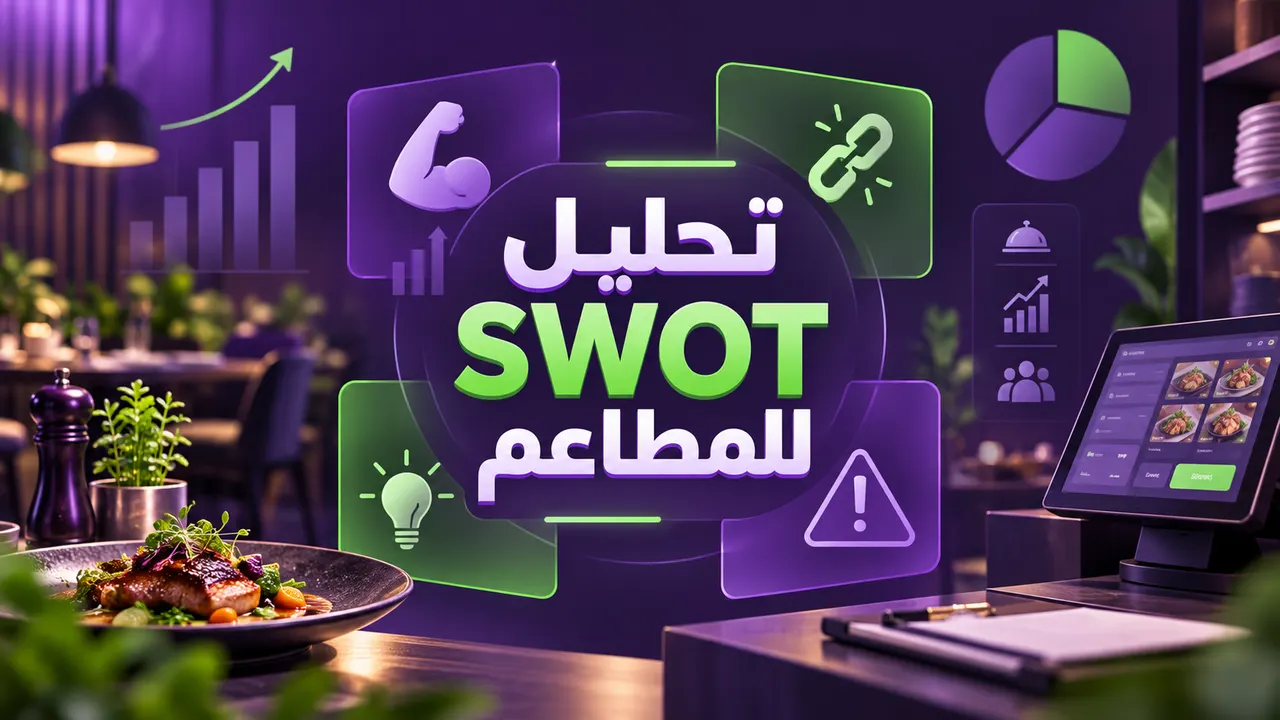
Running a successful restaurant does not depend only on food quality or a good location; it requires a clear understanding of what is happening inside the restaurant and what is changing around it in the market. A SWOT analysis for restaurants helps restaurant owners assess strengths and weaknesses, discover growth opportunities and prepare for threats that may affect sales and profits.
For the analysis to be effective, it must rely on real data, such as best-selling items, peak times, average bill value, inventory levels, branch performance and expenses. That is why using a modern point-of-sale system has become an important part of decision-making; when sales, inventory and reports are available in one place, it is easier to see what is working and what needs improvement.
In this guide, we explain the concept of a SWOT analysis for restaurants, how to apply it, and how to turn its results into practical decisions that help improve performance and increase sales.
Manage your sales and inventory in seconds with Alcashier!
Control sales, inventory and users in moments, and give your business an integrated system that runs smoothly without complexity.
Create your store for freeWhat is a SWOT analysis for restaurants?
A SWOT analysis is a strategic planning method that evaluates four main elements of any business:
- Strengths
- Weaknesses
- Opportunities
- Threats
This analysis helps restaurants understand their internal performance and the external factors that may affect their growth. Its elements are divided into internal factors that management can influence, such as food quality, customer service, order speed, inventory management, staff training, pricing, menu design, branch performance and expenses. These factors show up in the strengths and weaknesses.
External factors, on the other hand, happen outside the restaurant and cannot be fully controlled, such as new competitors appearing, changes in customer behaviour, rising raw material prices, growing demand for delivery, tourist seasons and the spread of new technologies in the restaurant sector. These factors show up in the opportunities and threats.
Why does a restaurant need a SWOT analysis?
A restaurant's sales may be good, but that does not mean all operations are running efficiently. A SWOT analysis can reveal problems and opportunities that do not show up in total sales, such as high sales of a low-margin item, a particular branch performing poorly during a certain period, or profitable items that do not get enough attention on the menu.
The analysis helps organise these observations and turn them into a clear picture you can rely on when setting priorities and making management decisions.
Benefits of a SWOT analysis for restaurants
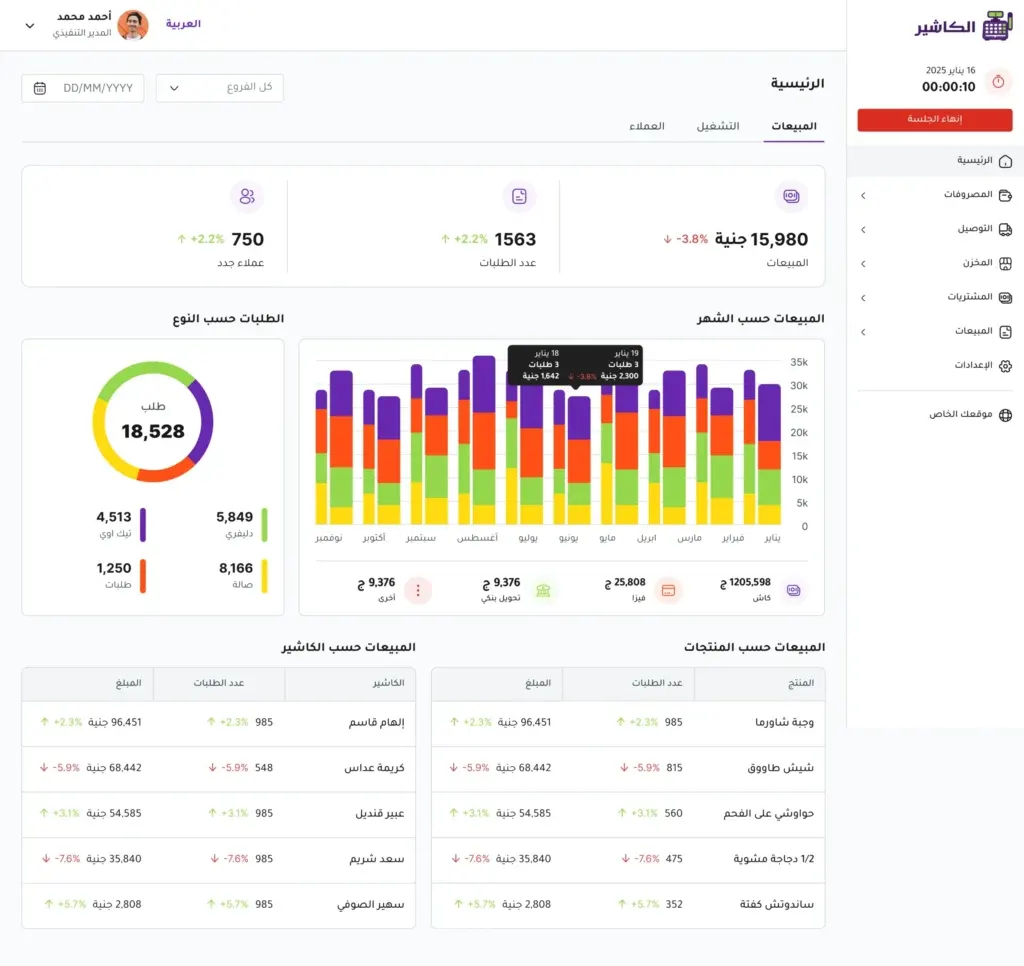
When carried out using accurate data, a SWOT analysis helps improve management decisions, understand restaurant performance and set development priorities. It may reveal the most successful items, the highest-selling periods, the best-performing branches, inventory and waste problems, and rising expenses.
It also helps you discover growth opportunities, such as adding a delivery service, launching an online ordering channel, adjusting the menu, offering deals during quiet periods or improving the customer experience. And a point-of-sale system provides the data needed to analyse these areas more accurately instead of relying on guesswork.
Element one: the restaurant's strengths
Strengths are the internal advantages that give the restaurant an edge or help it achieve good results. It is better for them to be specific and measurable rather than using general statements like “we have good food”.
Strengths may include a prime location, a base of repeat customers, good reviews, fast order preparation, distinctive recipes, fair prices, an experienced team, a well-known brand, low waste, good inventory management, a high average order value, and a successful delivery or pickup service.
Using sales data to identify strengths
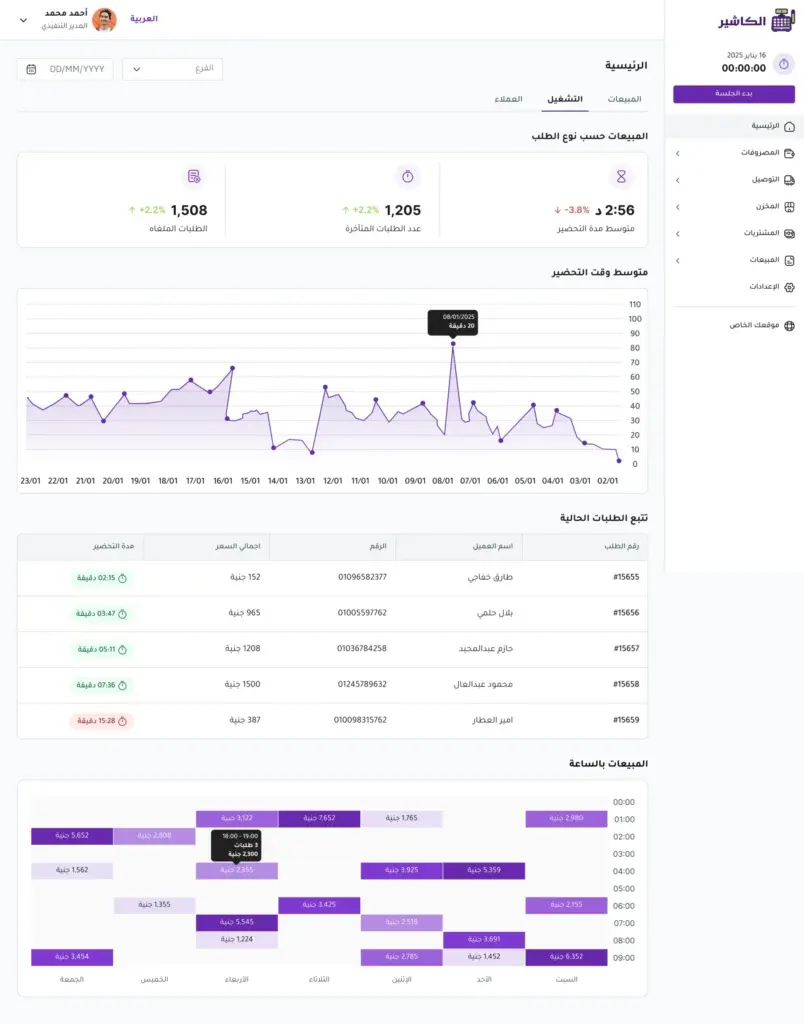
The reports of a sales management system help identify the most requested and highest-earning items, peak times, the best-performing branches and the most successful order types, whether dine-in, pickup or delivery.
For example, if the data shows that breakfast meals account for a large share of orders and have a high repeat-purchase rate, the breakfast menu may be one of your core strengths. You can use this insight in marketing campaigns, menu development and expansion decisions.
Element two: the restaurant's weaknesses
Weaknesses are the internal aspects that reduce efficiency or negatively affect the customer experience and profits. A SWOT analysis is not meant to prove that the restaurant is successful, but to clearly identify what needs improvement.
Weaknesses may include slow order fulfilment, reliance on manual processes, poor inventory management, order entry errors, high operating costs, low sales in certain periods, too many low-margin items, insufficient staff training, difficulty monitoring branches, a lack of accurate reports, recurring waste and slow payment.
How do reports reveal weaknesses?
An item may seem popular, but the sales report shows that demand for it is steadily falling. In this case, you should review the price, the quality, where the item sits on the menu, its preparation cost, customer feedback and the alternatives competitors offer.
A POS system may also show that a certain period suffers from slow transaction completion, or that some cashiers record fewer transactions than average. This data helps management spot the problem and fix it before it turns into a bigger loss.
Element three: opportunities available to the restaurant
Opportunities are external factors you can exploit to grow, increase revenue or reach new customers. They might include growing demand for delivery and online ordering, a new residential and commercial area emerging, increased tourism, the possibility of opening a branch, rising demand for a particular type of meal, offering deals to companies, launching a loyalty programme, adding seasonal products, or improving pickup services.
A practical example of spotting an opportunity
If sales are high on weekends and low midweek, this should not be seen only as a problem, but as an opportunity you can use through a special offer, corporate lunch meals, group deals, exclusive products or campaigns targeting past customers.
After launching the offer, you can use a cashier system to track the number of orders and the average bill and compare the results with the previous period. This way, marketing decisions become measurable rather than random experiments.
Element four: threats facing restaurants
Threats are external factors that may negatively affect the restaurant if it does not prepare for them. Examples include nearby competitors opening, rising food prices and operating costs, changing consumer preferences, reliance on a single sales channel, seasonal drops in demand, labour shortages, supply problems, higher delivery platform fees and fast-changing food trends.
If the cost of a key ingredient such as meat or dairy goes up, the profit margin on some items may fall. Raising the price is not the only solution; you can review sales volume, revenue, substitute products, the possibility of changing the recipe or portion size, and which items could be promoted in place of the affected one. A point-of-sale system helps you make these decisions based on clear data.
A SWOT analysis example for a restaurant
Suppose you have a local burger restaurant that serves dine-in orders and delivery. The analysis could include the following:
Strengths
- Good customer reviews.
- A distinctive burger recipe.
- High demand in the evening.
- A large number of repeat customers.
- Fast order preparation.
Weaknesses
- Weak sales at lunchtime.
- High cost of some ingredients.
- Some items with low demand.
- Heavy reliance on an external delivery platform.
- No offers targeting past customers.
Opportunities
- Growing demand for corporate lunch meals.
- Launching direct online ordering.
- Creating deals for family orders.
- Opening a branch in a new area.
- Offering seasonal products.
Threats
- A burger chain opening near the restaurant.
- Rising meat prices.
- Increased delivery platform fees.
- Customers shifting towards healthier options.
Once these elements are identified, the most important step begins: turning them into decisions and measurable actions.
How do you carry out a SWOT analysis for your restaurant?
Gather your restaurant's data
Start by collecting sales and operations data, such as total sales, number of orders, average bill value, best- and worst-selling items, staff and branch performance, sales by time, inventory levels, expenses, payment methods and order types.
This task becomes easier with a restaurant cashier system that brings operations and reports together in one system.
Talk to your team and review customer feedback
Reports do not reveal everything; staff deal with customers and daily operations and may notice problems that do not show up in the numbers. Ask them about recurring complaints, products that take a long time, peak-hour problems, unavailable items and the reasons orders are delayed.
Also review customer ratings and comments, and look for recurring patterns. Repeated praise for fast service may point to a strength, while repeated complaints about delays reveal a weakness that needs to be addressed.
Watch your competitors and categorise the findings
Watch competitors' prices, menus, offers, delivery services, ordering methods, customer experience, new branches and reviews, with the aim of understanding the market rather than copying others.
Then sort the findings into four groups: What are we doing well? What needs improvement? Where can we grow? And what might affect us in the future?
Set priorities
Rank the items by their impact on revenue and customer experience, ease of implementation, cost and how urgent the problem is. If slow payment affects a large number of customers every day, improving the sales process may be a higher priority than adding a new item to the menu.
How does a point-of-sale system help with a SWOT analysis?
It is hard to run an accurate analysis when data is scattered across notebooks, spreadsheets and different systems. A centralised point-of-sale system gives a clearer view of sales, inventory, branches and staff, and helps you identify the best-performing products, analyse sales by time, track inventory and compare branch performance.
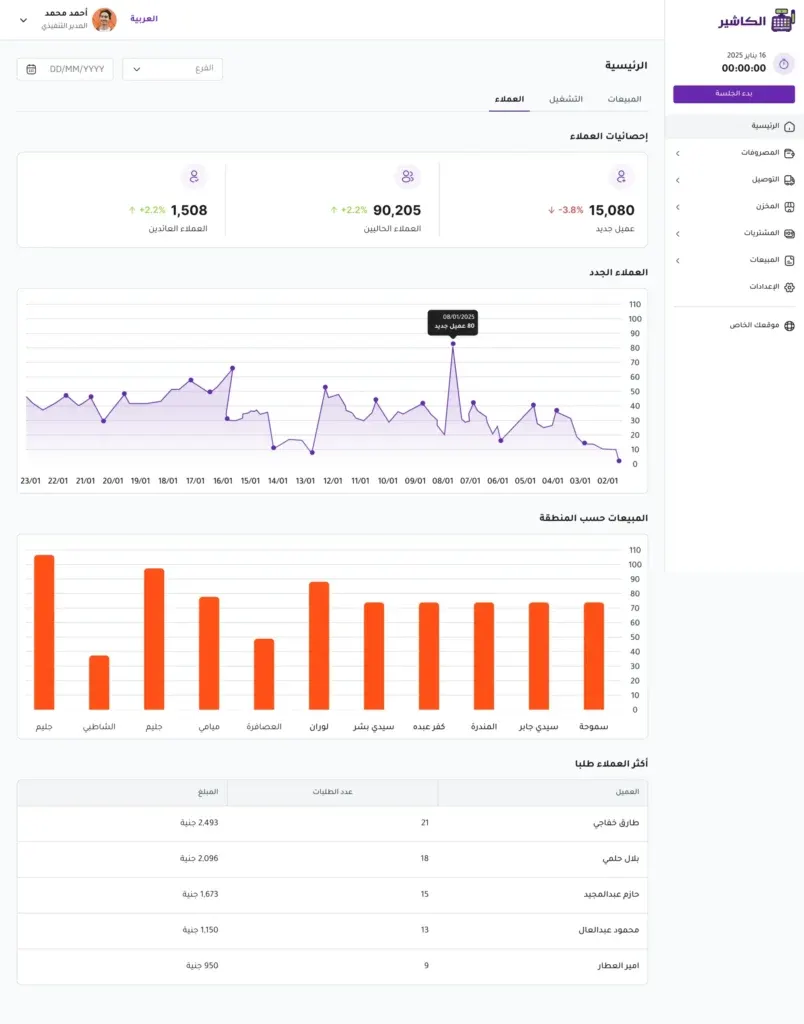
Sales reports may reveal that most orders happen during certain hours, which helps you optimise staff allocation, offers, working hours and advance preparation. Inventory reports also reveal products that keep running out, slow-moving stock, waste problems and opportunities to improve vendor orders.
When managing several branches, relying on total revenue is not enough; one branch may achieve high sales while another struggles because of location, working hours, customer type, staff performance or differences in the products requested. Comparing branches helps you understand these differences and make more accurate decisions.
Using Alcashier to turn data into better decisions
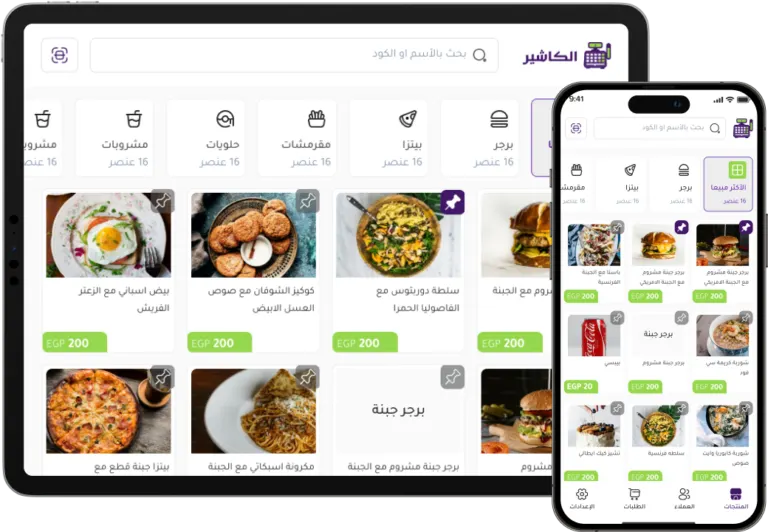
A modern system like Alcashier helps restaurant owners manage sales, inventory, branches and staff from one place, while providing the reports needed to understand business performance. With this data, you can identify product performance, sales trends, inventory movement, branch performance and order types, which are important indicators in a SWOT analysis.
Alcashier also works online and offline, so sales can continue when the internet connection is weak, which matters for restaurants that need to serve customers without interruption.
What data should you track continuously?
Track total sales, number of orders, average bill value, item sales, sales by time, inventory levels and branch performance. Do not rely on revenue alone; it may rise because of price increases while the number of customers falls. Tracking the average bill also helps you understand customer spending, item sales reveal which products need improvement, and time data shows peak hours and quiet periods.
How do you use SWOT to improve your menu?
You can combine a SWOT analysis with menu performance analysis by identifying the most and least requested items, products with steady sales, seasonal products and items with recurring inventory problems. Then ask whether there is an opportunity to boost sales of a particular item, a weakness caused by too many options, a threat from the rising cost of a key ingredient, or a strength in a category that could be expanded.
These questions tie the analysis to daily revenue and help you make better decisions about adding, adjusting, promoting and removing items.
Manage your sales and inventory in seconds with Alcashier!
Control sales, inventory and users in moments, and give your business an integrated system that runs smoothly without complexity.
Create your store for freeConclusion
A SWOT analysis for restaurants is not just a table of strengths, weaknesses, opportunities and threats, but a tool that helps the restaurant owner understand their business and make decisions grounded in reality. Start by identifying what is working inside the restaurant, then address the weaknesses, and watch the market to discover growth opportunities and prepare for threats.
Relying on data remains the most important factor. When you use a system like Alcashier to manage sales, inventory, branches, staff and reports, it becomes easier to turn daily numbers into information that helps you take smarter steps.
Whether you run a small restaurant or several branches, combining a SWOT analysis with the right point-of-sale system gives you a clearer view of your business's performance and helps you know where you stand now and what the next step for growth is.

How to attract tourists to your restaurant: 12 strategies to boost sales with restaurant POS software
Tourists are an important opportunity for restaurants, especially in cities and areas with constant tourist traffic or seasons and events that attract visitors from…
Restaurant sales reports: your guide to understanding customers and increasing profits with a POS system
A restaurant's success no longer depends only on the quality of the food, the location of the branch, or the skill of the service team. These elements are still…
POS software for cafés: how to prepare for the World Cup 2026 rush
Major match days are a golden opportunity for cafés, especially during the World Cup, when customers gather to watch the matches, order drinks, try offers,…
The post SWOT analysis for restaurants: how to better understand your restaurant's performance appeared first on Alcashier.