The restaurant cashier job is one of the most important jobs in the hospitality and restaurant sector. It is the final front line the customer deals with before leaving, and the link between the service team, accounting, and management. This job is not limited to receiving money or issuing invoices; it includes precise tasks related to organizing orders, managing financial operations, and ensuring an outstanding customer experience that reflects the restaurant's image and the quality of its services. In the modern restaurant world, the cashier job is no longer just collecting money; it has become a cornerstone of managing daily operations and delivering a complete, professional customer experience. With the rapid digital transformation of the hospitality sector, the restaurant cashier job has evolved to keep pace with smart point-of-sale (POS) systems that simplify operations and reduce errors, and tools such as Alcashier have become a step change in how sales, inventory, and customer service are managed.
According to a 2024 report from Statista, about 70% of restaurants that use digital POS systems achieve 35% higher financial accuracy than restaurants that still rely on traditional methods, which highlights the pivotal role the cashier plays in digital transformation and operational efficiency in modern restaurants.
What does a restaurant cashier do?
The cashier's job in a restaurant is to manage the entire payment process, from the moment the order is recorded until the final bill is handed over. The cashier is the intermediary between the customer and the kitchen, and between management and revenue, and makes sure every financial transaction is carried out accurately and transparently.
Daily duties in detail
Greeting customers and confirming orders:
When a customer walks into the restaurant or orders by phone or through apps, the cashier confirms the order and records it in the system.
Issuing invoices:
Invoices must be issued quickly and with high accuracy to avoid any confusion or delay.
Managing multiple payment methods:
Whether it is cash, bank card, or electronic wallets, the cashier must know and master every method.
Managing discounts and offers:
During promotions, the cashier activates coupons or specific discounts that are applied automatically through the system.
Closing the daily cash:
At the end of the day, the cashier reviews all transactions and makes sure the revenue matches the reports produced by the system.
In large restaurants or chains, the cashier often takes on additional tasks such as coordinating orders between branches or sending daily revenue reports to the finance department.
Skills of a successful restaurant cashier
For the cashier to work with high efficiency, they must combine technical and behavioral skills. It is not only about knowing how to use the system, but also about human interaction and effective communication.
1. Accuracy and attention to detail
The cashier handles hundreds of transactions a day, which means any small mistake can cause financial losses or inventory problems.
A professional cashier double-checks prices, quantities, and offers before completing each transaction. Systems like Alcashier help reduce these errors through automatic alerts and double verification before closing.
2. Communication and customer service skills
The cashier is not just a financial employee, but the restaurant's brand ambassador. The way they speak, their tone of voice, and how quickly they deal with people all shape the customer's impression.
According to a survey by Forbes Hospitality Insights, 83% of customers said a smooth and friendly payment experience encourages them to come back to the restaurant.
3. Speed of performance and time management
During peak times, such as lunch or dinner, speed is a decisive factor.
An effective cashier knows how to handle several orders at once without getting distracted, and uses the features of the smart system to shorten the time between ordering and paying.
4. Familiarity with modern technology
Systems like Alcashier have made the cashier's role more advanced.
Today a cashier must be able to:
- Use interactive screens.
- Manage online orders.
- Tracks inventory in real time.
- Work with printers and digital invoices.
The role of technology in developing the cashier job
In the past, the cashier relied on paper, notebooks, and calculators, but today they manage complex operations through integrated digital systems. Technology has made the cashier job more accurate, efficient, and professional.
1. Point-of-sale systems (POS Systems)
Systems like Alcashier unify all operations in one interface: recording the order, issuing the invoice, managing payment, updating inventory, and sending financial reports. These systems reduce human error and improve service speed by up to 40% in some restaurants.
2. Integration with delivery apps
In the age of takeout orders, it has become essential for the cashier system to integrate with delivery apps. This integration prevents duplicate orders and updates prices automatically, so the cashier can follow all channels from one place.
3. Instant analytical reports
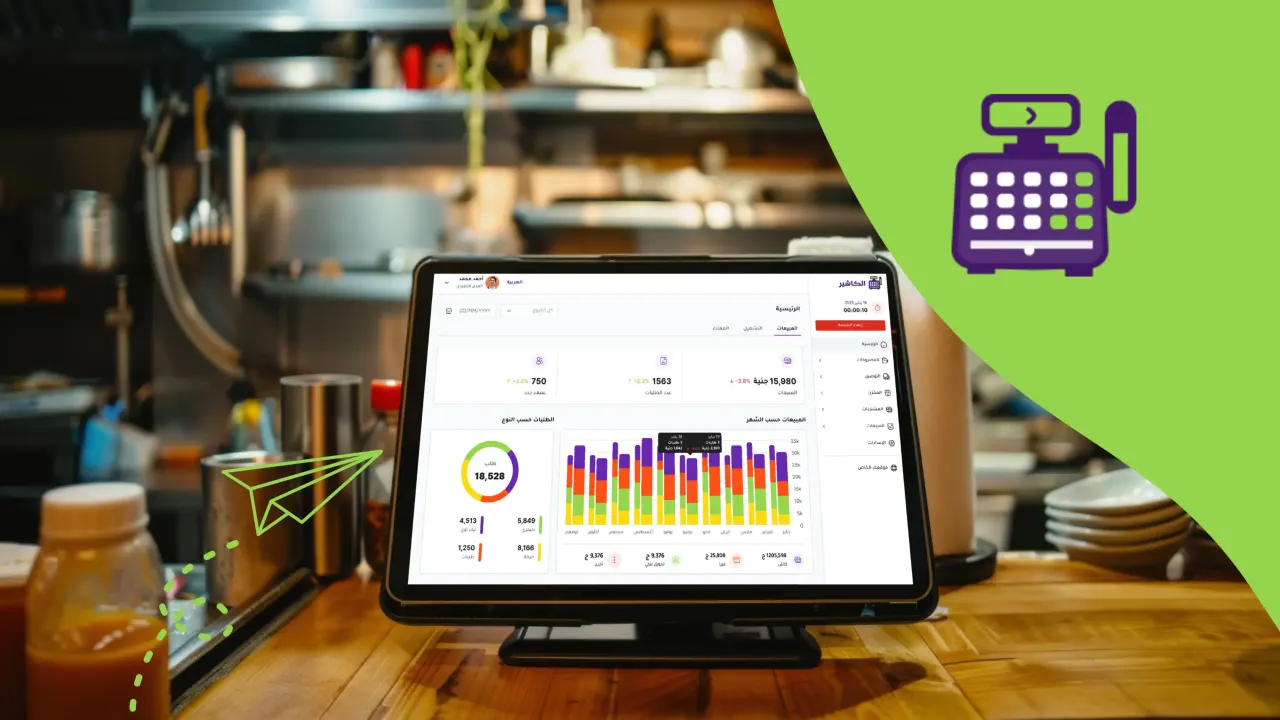
The cashier and the manager can now see accurate data in real time:
- Best-selling items.
- Daily revenue.
- Peak hours.
Each employee's performance.
This data enables management to make decisions based on numbers, such as adjusting the menu or improving staff schedules.
4. Working offline (Offline)
One of the standout features of Alcashier is the ability to work offline. Even when the internet goes down, the system keeps recording transactions and syncs them later when the connection returns, ensuring service continues without any interruption.
How has the cashier job changed with digital transformation?
Digital transformation has radically changed how restaurant owners view the cashier job.
The job is no longer just “collecting payment”; it has become a hub for information and management.
1. From manual calculation to smart management
Today, through the system, the cashier can follow sales, see which items need restocking, and even send alert notifications to management when the quantity of a certain product runs low.
2. From routine work to analysis
The cashier now takes part in monthly performance reports and suggests improvements based on the actual data they see in the system.
3. From paper handling to full digital transformation
There is no longer a need for traditional paper invoices, as the invoice can be sent by email or QR code, which promotes sustainability and cuts operating costs.
The importance of the cashier job to restaurant success
Studies show that the payment experience is one of the most important factors in how customers rate a restaurant.
According to the Deloitte Food Experience 2024 report, 58% of customers consider a smooth payment process a key factor in their overall satisfaction.
1. The cashier is the gateway to revenue
Without an accurate cashier, restaurants can suffer financial losses from calculation mistakes or incorrect sales entries. This is where modern systems like Alcashier come in, providing automatic daily reports and preventing duplication or omissions.
2. Improving the customer experience
A cashier who uses a modern system can issue invoices quickly and deliver a smooth experience to the customer, which leaves a positive impression and increases the likelihood of a return visit.
3. Internal organization
The cashier also helps connect operations between the kitchen, service, and accounting. They are the connecting point that keeps work flowing smoothly at every moment.
Alcashier and its role in empowering staff
POS systems like Alcashier do not replace the cashier, but empower them to work more efficiently.
Here is how:
- Ease of use: The simple interface lets new staff be trained in just a few hours.
- Fewer errors: The system automatically checks prices and quantities before completing the invoice.
- Accurate financial reports: Real-time reports on revenue, sales, and inventory.
- Arabic language support: Which makes it comfortable to use and well suited to the Saudi market.
- Online store integration: If the restaurant has its own website or app.
In this way, the cashier job turns from a mere “transaction processor” into a smart operator of the restaurant's financial system.
Daily challenges facing the cashier
Despite the great benefits, the cashier faces challenges that call for skill and patience:
- Work pressure during peak times.
- Solving immediate problems such as declined payment cards or changing customer requests.
- Staying accurate and focused despite the high number of transactions.
- Keeping up with technology as POS systems are constantly updated.
- But good training and ongoing technical support from modern systems help overcome these challenges easily.
Daily challenges facing the cashier
With the advance of AI, the cashier job is becoming more strategic than ever.
The job will not disappear; it will evolve to become more supervisory and analytical.
In the future, the cashier will:
- Manage smart payment systems.
- Analyze sales data.
- Improve the customer experience based on buying behavior.
And Alcashier will be part of this future thanks to its advanced analytical reports and full support for automation in sales and management operations.
Conclusion
The cashier job in restaurants is the heart of daily operations, combining human interaction and technology at once.
With the adoption of modern systems like Alcashier, the task is no longer as exhausting as it used to be, but smarter and better organized.
Today's cashier does not just issue invoices; they take part in decision-making, performance analysis, and improving the customer experience.
That is why investing in cashier training and using a reliable system is one of the key ingredients of success for any restaurant in the Saudi and Arab market.
Frequently asked questions (FAQ)
1. What are the cashier's most important duties in a restaurant?
Recording orders, issuing invoices, managing payments, and accurately reviewing daily revenue.
2. Does a cashier need a specific qualification?
No specific qualification is required, but those with degrees in accounting, hospitality, or business administration are preferred.
3. What are the most prominent skills required?
Accuracy, speed, communication skills, and good knowledge of modern POS systems.
4. Can the system be used without an internet connection?
Yes, Alcashier supports offline operation with automatic sync when the internet returns.
5. Is the cashier job suitable for beginners?
Yes, it is one of the best jobs for gaining customer-handling and financial management skills.
What is the best point of sale software for restaurants? Here is the complete answer
In light of the rapid development of the food and beverage sector, searching for the best point of sale software for restaurants has become a necessity for anyone…
The best free restaurant cashier software
In the ever-faster, ever-evolving world of restaurants, success no longer depends only on the quality of the food or the location of the restaurant, but on the efficiency of…
The best free supermarket cashier software
In the world of modern commerce, where competition is growing and customer expectations rise day by day, having a complete supermarket cashier software has become…
The post Restaurant cashier job: duties and required skills appeared first on Alcashier.