In the fast-moving business environment in Saudi Arabia, and with the digital transformation led by Vision 2030, traditional systems have become a burden on the growth of commercial businesses. Relying on a manual cashier today is like driving on a highway in an old car: slow and full of breakdowns. This article highlights the main challenges shop owners face with a manual cashier, and offers practical, effective solutions using the smart cashier.
First: what is a manual cashier?
It is a traditional system based on recording sales by hand, whether in a notebook, an Excel spreadsheet, or a simple device not connected to any management systems. Although it may be low-cost at first, its negative effects show up over time, especially in fast-growing stores or those dealing with large inventory.
The main problems with a manual cashier:
1. Human errors in calculations and pricing
When using a manual cashier, the employee is responsible for entering every price by hand and doing the calculations without any technical support. This makes the error rate very high, especially at peak times or when there are discounts and offers. A simple mistake entering a number can cost the store a whole day's profit, and can cause repeated customer complaints.
A real-life example: imagine an employee who entered a product at 12 SAR instead of 120 SAR. In a manual system, there is no alert or automatic check, and the mistake may not be discovered until the end of the day or even the end of the month.
2. Incompatibility with government systems and e-invoicing requirements
Since e-invoicing (Fatoorah) was introduced in Saudi Arabia, every business has needed to use a system capable of issuing documented e-invoices that comply with the requirements of the Zakat, Tax and Customs Authority.
A manual cashier cannot issue e-invoices, and does not record VAT correctly, which exposes the store owner to accountability and financial fines.
3. Chaos in inventory and order management
A manual cashier system does not integrate with stocktaking and does not update inventory automatically. This means the store owner may not know the available quantity of a given product, or when to reorder from the vendor. This leads either to running out of goods and losing sales, or to excess stock that hurts cash flow.
Direct impact: if you run a supermarket and couldn't tell that a staple product had run out, you may lose customers to a competitor who has that product and runs a smart cashier system that automatically flags low quantities.
4. No financial analysis or performance data
In business, a data-driven decision is the smartest path to growth. But with a manual cashier, it is hard, if not impossible, to know total daily sales, each employee's sales rate, or the most profitable products.
As a result, management keeps relying on intuition and experience instead of accurate numbers. And that makes expansion risky.
5. Wasted daily time and effort
At the end of every day, the team has to review invoices by hand, close the accounts, do the stocktake, and perhaps record expenses manually. These processes drain valuable time that could be invested in serving customers or improving performance.
Imagine having a system that calculates everything automatically and gives you a comprehensive report in seconds. A manual cashier deprives you of this important feature.
6. No link between branches or devices
If the store has more than one branch, a manual cashier makes it hard to connect data and monitor performance centrally. Each branch works separately, which means conflicting data, difficulty in evaluation, and difficulty planning inventory or promotional campaigns.
The result? No overall visibility, and therefore no control.
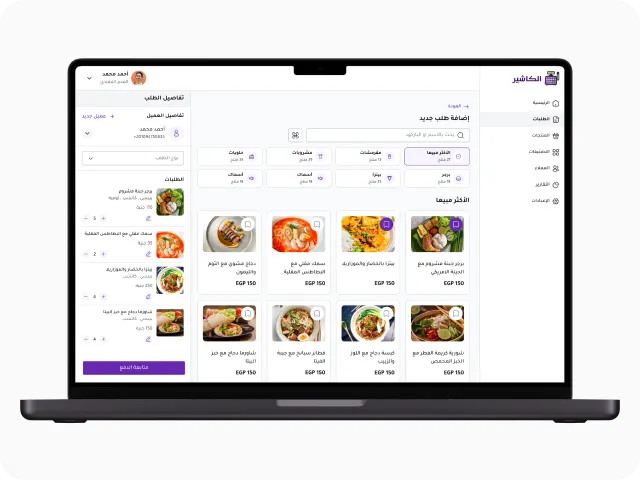
The smart cashier: the complete solution to daily challenges
The smart cashier system is not just a replacement, but a qualitative leap in store management. It offers an integrated platform combining sales, inventory management, staff, reports, e-invoicing, and more, through an easy interface that supports Arabic and suits the Saudi market.
Features of the smart cashier:
 Fewer errors and more accurate invoices:
Products are priced automatically, and overriding the set price is not allowed.
Discounts, VAT, and loyalty points are calculated automatically.
E-invoices are printed with a QR code approved by the Zakat and Tax Authority.
Smart inventory management:
Every sale deducts from the quantity automatically.
You receive notifications when stock runs out or runs low.
Products are classified by code, section, vendor, or expiry date.
Detailed real-time reports:
Sales reports by day, employee, branch, or product type.
Analysis of the best- and worst-performing products.
Comparison between periods (for example: Ramadan this year compared with last year).
Staff and permissions management:
Set permissions for each employee (for example: preventing price edits).
Track each employee's performance by number of sales and average invoice.
Employee login and logout records and shift management.
Support for multiple branches and devices:
A unified dashboard for all your branches.
Automatic sync between devices, even when working without internet.
Remote access from anywhere.
Supports Arabic and works online and offline:
Suitable for employees who don't speak English.
Even if the internet goes down, the system keeps working and the data is synced later.
Summary
In a highly competitive business environment, there is no time to try old solutions. A manual cashier may cost less at first, but it carries a large hidden cost in the long run through losses in time, accuracy, and profitability. The smart cashier, on the other hand, is an investment in growth, helping you manage your store with confidence, accuracy, and speed.
10 cashier system secrets that few people know
Cashier systems are no longer just a way to issue invoices and receive payments. They have become an integrated hub for managing business operations, analyzing performance and providing…
Alcashier: the best cashier system for restaurants
The fast pace of work in the restaurant sector now demands heavy reliance on digital solutions. Technology has become a pivotal tool for delivering an experience…
Alcashier: the best restaurant software for managing your business with ease
In the fast-changing, ever-evolving world of restaurants, success no longer depends only on the quality of the food or a prime location. It has become…
The post Problems with manual cashiers and smart cashier solutions appeared first on Alcashier software.