The modern restaurant sector in the Kingdom of Saudi Arabia is experiencing an unprecedented boom thanks to technological progress and rapid digital transformation. With the wide spread of smartphones and a rising number of internet users, food delivery apps and websites have become an essential part of the everyday consumer experience. Ordering a meal is no longer limited to a phone call: today's customer browses menus, picks their favorite dishes and chooses how to pay, all with a few taps on a phone screen.
This radical change has not only affected consumer behavior. It has reshaped the business model of modern restaurants, which now see digital delivery platforms as a core sales channel just as important as the physical dining room. At the same time, competition between restaurants in the Saudi market has become fiercer.
Here the key question arises: how can modern restaurants benefit from this digital revolution without falling into the trap of administrative complexity or excess costs? The answer lies in integrating advanced sales management systems such as Alcashier with popular delivery apps, enabling integrated management of orders, inventory, staff and expenses on one easy-to-use platform.
In this article, we review the latest statistics on the food delivery market in Saudi Arabia and discuss the main opportunities and challenges facing restaurants, with practical tips and technical solutions that help restaurant owners get the most out of combining modern technology with digital delivery services.
Benefits of going digital for modern restaurants
1. Expansion of the digital market
- According to a ResearchAndMarkets report, the Saudi food delivery market was worth about USD 2.98 billion in 2024 and is expected to grow to USD 8.22 billion by 2030, at a compound annual growth rate of 18.4%.
- Another report estimates the market size at USD 2.48 billion in 2023 and projects it to reach USD 7.95 billion by 2029, at an annual growth rate of 21.4% (Source: GlobeNewswire).
- According to data from Grand View Research, the market size in 2024 was approximately USD 7.98 billion and is expected to reach USD 12.98 billion by 2030, at an annual growth rate of 9%.
2. Mobile phone adoption and ease of use
Forecasts indicate that more than 80% of food delivery orders in Saudi Arabia and the UAE will be placed via mobile phones by the end of 2026 (Source: Fast Company ME).
3. Growth across different restaurant categories
- The Saudi foodservice market is estimated at approximately USD 30.12 billion in 2026 and is expected to rise to USD 44.67 billion by 2030, at an annual growth rate of 8.2% (Source: Entrepreneur).
- Quick-service restaurants (QSR) are expected to reach USD 10.35 billion in 2026 and expand to USD 14.19 billion by 2030. Full-service restaurants (FSR) are growing from USD 16.15 billion in 2026 to USD 24.12 billion by 2030. The cloud kitchen market is on track to reach USD 335.7 million by 2030, at an annual growth rate of 7.7% (Source: Restroworks).
4. Evolving electronic payment methods
The Mada network stands out with its strong presence in Saudi Arabia, with more than 1.7 million point-of-sale (POS) devices, 8.9 billion transactions worth SAR 613.9 billion, and more than 47.7 million Mada cards (Source: Wikipedia). This integration makes food delivery easier and safer.
How does "Alcashier" strengthen its position as an all-in-one solutions provider for modern restaurants?
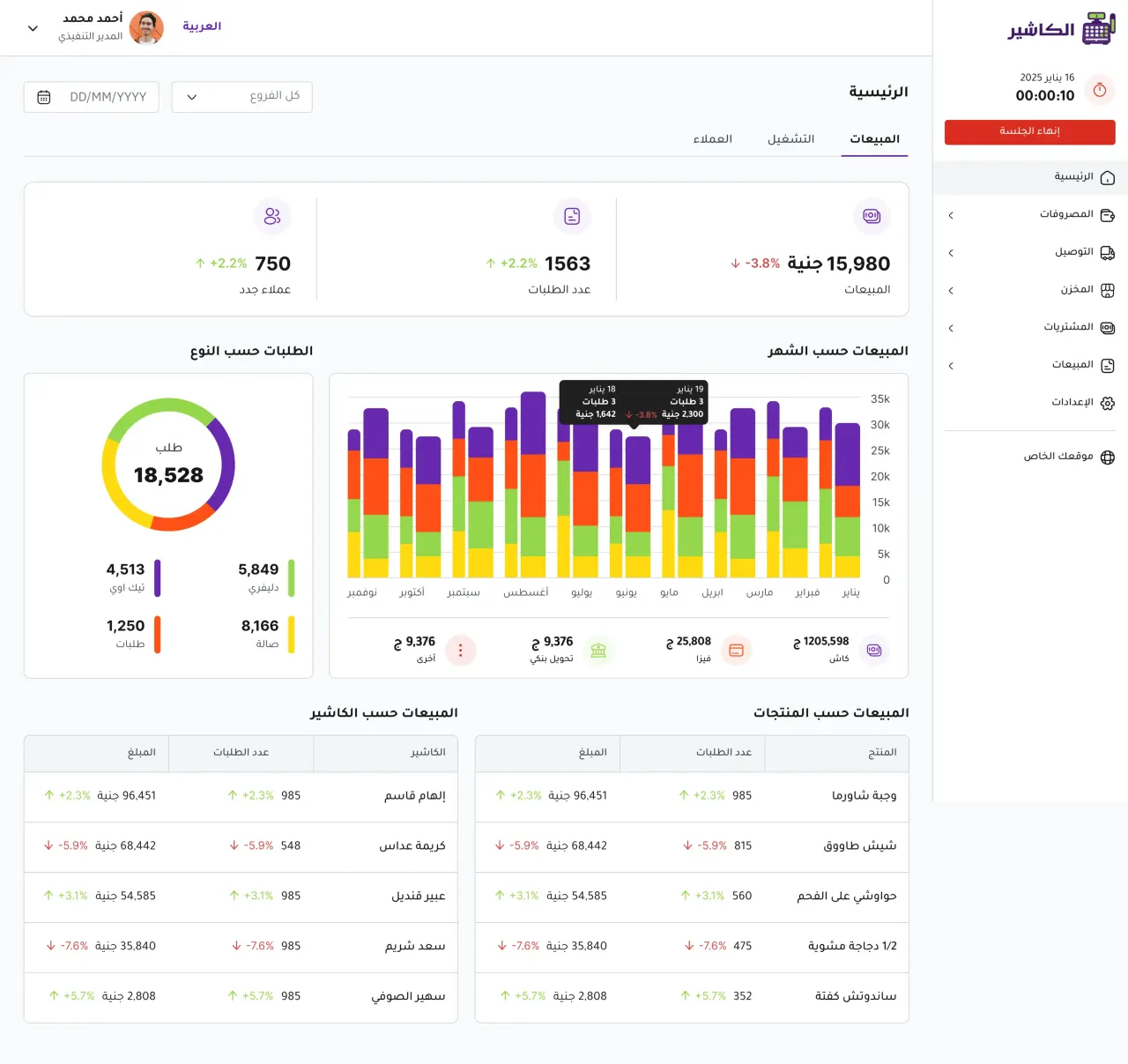
Alcashier offers a comprehensive platform for managing restaurant businesses smartly and efficiently, giving you control over sales, inventory, expenses and staff in real time. That makes it the ideal solution for integrating with food delivery apps and websites. The system works smoothly both online and during outages, with full support for Arabic and English, ensuring work continues without any interruption or data loss.
To boost sales opportunities and digital presence, Alcashier also provides a dedicated website for displaying products and selling them directly to customers, so restaurant and store owners can manage orders and sales through the website. It is fully integrated with the Alcashier app to update inventory, record invoices and process payments automatically.
When a modern restaurant adopts Alcashier, it can follow orders coming in from the website, update inventory instantly, track financial performance accurately, and give customers faster, more professional service. This gives it a clear competitive advantage in the market.
Risks and challenges of delivery apps in the Saudi market
Despite the strong growth of the food delivery sector in Saudi Arabia, restaurants and digital platforms alike face a number of challenges that call for smart strategies to handle them:
1. Strict regulations and food safety requirements
The Ministry of Health and the Saudi Food and Drug Authority impose precise standards to ensure food safety and service quality, including requirements for food storage and packaging, hygiene standards, and training delivery staff in handling orders. These regulations, while important for protecting consumers, can increase operating costs or delay the launch of new restaurants or platform expansions, especially if the business is not prepared to meet these requirements.
2. Fierce competition between platforms
The Saudi market sees strong competition between major players such as HungerStation, Talabat, Mrsool and Careem, each seeking a bigger share of customers through promotions, fast delivery services and expansion into smaller cities. This intense competition can squeeze restaurants' profit margins, as they are forced to offer discounts or pay higher commissions to attract customers and keep their loyalty.
3. New players entering and changing the rules of the game
The market is not closed to local and regional players only. It is also seeing international competitors with extensive experience and large investments. One example is the reports about the entry of China's Meituan, one of the largest delivery platforms in the world, through its KeeTa app, which could reshape the competitive landscape and increase pressure on prices and the services offered.
4. Volatile operating and logistics costs
Rising fuel prices, changing labor costs and a shortage of qualified staff for fast delivery are all factors that can affect the continuity and cost of the service, especially in remote cities or low-demand areas.
5. Changing consumer preferences
With many restaurant and app options available, Saudi consumers have become more aware of offers and prices and less loyal to a single brand. This forces restaurants and platforms to keep improving the user experience and offer innovative services to retain customers.
How modern restaurants overcome the challenges with Alcashier
Amid strong competition, strict regulations and changing consumer behavior, modern restaurants in Saudi Arabia need integrated solutions that help them adapt quickly and achieve sustainability. This is where Alcashier comes in, as a comprehensive management platform that connects the restaurant's internal operations with external sales channels.
1. Managing orders from multiple sources
Through direct integration with delivery apps and websites, Alcashier lets you follow all orders in a single dashboard, whether they come from the dining room, the phone or external apps, which reduces errors and saves staff time.
2. Better inventory management
Every sale, whether in the restaurant or through delivery, automatically updates inventory, which prevents popular items from running out and keeps customers satisfied.
3. Controlling costs and increasing profitability
Alcashier provides accurate real-time financial reports that help restaurant owners analyze operating costs, fine-tune promotions and identify the most profitable dishes.
4. Digital presence through the products website
Through the website integrated with Alcashier, a restaurant can display its products and sell them directly online, giving it an additional sales channel alongside delivery apps, which reduces dependence on a third party and increases profit margins.
5. Multi-language support and offline operation
Alcashier supports Arabic and English and keeps working even when the internet is down, ensuring service continues without interruption or losses.
In short, Alcashier gives restaurants a mix of operational flexibility, smart management and digital integration, making it possible to overcome the challenges of the Saudi delivery market while staying profitable.
Best practices for modern restaurant success
To achieve success and continuity in the Saudi restaurant and delivery market, relying on food quality alone is not enough. You need to apply smart, technology-backed strategies. Below are the main practices, with practical steps for each:
1. Technical integration with management systems
Digital transformation has become a necessity, not an option.
Practical steps:
- Connect popular delivery apps (HungerStation, Talabat, Mrsool) directly to the Alcashier system.
- Set up a central dashboard to receive all orders in one place.
- Turn on automatic inventory updates after every sale.
- Train staff to use the system to ensure fast, accurate execution.
2. Offering diverse payment options
A variety of payment methods increases customer uptake.
Practical steps:
- Enable electronic payment via Mada and digital wallets (Apple Pay, STC Pay).
- Keep cash on delivery as an option to cover all customer segments.
- Review Alcashier reports to find the most-used payment methods and offer promotions tied to them.
3. Improving the user experience (UX)
An excellent digital experience attracts customers and keeps them loyal.
Practical steps:
- Design clear menus with professional photos of every dish.
- Reduce the number of ordering steps in the app or website.
- Offer order customization (adding, removing or changing ingredients).
- Regularly test the loading speed of the website or app to ensure optimal performance.
4. Using analytics and data
Data-driven decisions are more accurate and effective.
Practical steps:
- Track peak times to decide when to add more staff.
- Analyze sales data to find the most profitable and most requested dishes.
- Prepare monthly reports to compare performance and identify trends.
- Use data to design campaigns and offers tailored to your most loyal customers.
5. Smart digital marketing
Continuous marketing keeps the brand present in customers' minds.
Practical steps:
- Optimize the restaurant's website for search engines (SEO) by choosing the right keywords.
- Launch paid campaigns on social media platforms with engaging content.
- Collaborate with local influencers to try the restaurant and promote it.
- Create a loyalty program that gives customers points or discounts on every repeat purchase.
Frequently asked questions (FAQ)
Why are delivery apps becoming more important for restaurants?
Because they widen the customer base to include segments restaurants never reached before, whether in the same city or in remote areas. They also provide an additional, ongoing source of income outside the dining room, which strengthens financial stability and increases growth opportunities.
How can Alcashier help restaurants manage orders?
Through direct integration with delivery apps and websites, the restaurant receives all orders on a single platform, which speeds up fulfillment and reduces errors. It also updates inventory automatically and provides instant financial reports that help management make accurate and timely decisions.
Are cloud kitchens a profitable option?
Yes, because they cut operating costs by removing the need for a customer-facing location, and let you focus on preparing orders for delivery only. They also benefit from the growing demand for delivery services, making them an ideal model for growth in the digital market.
Conclusion
Modern restaurants in Saudi Arabia are living in an unprecedented digital era, as innovation accelerates amid steady growth in market value, wide smartphone adoption and a great variety of restaurant options, from fast food to fine dining to cloud kitchens. This shift is no longer a passing trend. It is a reality that requires restaurant owners to keep up with technological developments to stay in the competition.
Alcashier is a key technical pillar at the heart of this change, offering integrated solutions that cover sales, inventory, expenses and staff management, with direct integration with delivery apps and websites. This blend of technology and smart management lets restaurants make full use of digital orders, deliver faster and more accurate service, and strengthen customer loyalty.
By relying on up-to-date data, continuous analytics and effective management tools, restaurants can grow with confidence and stand out in a fast-paced, competitive environment, staying at the front of the Saudi market and benefiting from every opportunity this digital era offers.

Saudi Vision 2030: a qualitative leap in the restaurant and café sector
Saudi Vision 2030 is an ambitious strategic plan set by the Kingdom. It aims to diversify the sources of the economy and reduce dependence on oil. While achieving…
Restaurant financial management: the best strategies to cut operating costs and increase profitability
In the Saudi restaurant market, which is seeing steady growth and fierce competition, effective financial management is the cornerstone of maintaining stability…
The mobile cashier: a revolution in modern point of sale systems
The retail sector in the Kingdom of Saudi Arabia is undergoing rapid digital transformation. The mobile cashier has become one of the most important solutions helping store owners…
The post Modern restaurants and the food delivery apps and websites revolution: a smart experience driven by technology appeared first on Alcashier.